BJJ vs MMA: Which Should You Train First?
· By Master Willy (Guillermo) Hardoy
If you have typed "MMA near me" into Google, there is a good chance you already have a picture in your head: a cage, two fighters trading strikes, maybe a takedown that ends in a scramble on the mat. Mixed Martial Arts is exactly that combination, striking, wrestling and grappling blended into one ruleset. But before anyone steps into a cage, almost every serious fighter spends real time on the ground learning Brazilian Jiu-Jitsu, because the ground is where fights are controlled and finished.
This article breaks down what MMA actually is, what BJJ is, how the two connect historically, and how to think about which one fits your goals right now, whether that goal is general fitness, self-defense, competition, or a long-term interest in fighting. If after reading this you are still curious about MMA specifically, you can always ask us directly on WhatsApp and we will point you in the right direction.
What MMA Actually Is
Mixed Martial Arts is a combat sport that allows athletes to use techniques from multiple disciplines in the same match: boxing and kickboxing for striking, wrestling for takedowns and control, and Brazilian Jiu-Jitsu or other grappling arts for the ground game. Matches happen inside a cage or ring under a unified ruleset that limits dangerous techniques (no eye gouging, no small joint manipulation in most organizations) while still allowing full-contact striking and submission attempts.
Because MMA pulls from so many different arts, no single discipline covers everything a fighter needs. A boxer with no takedown defense gets taken down. A wrestler with no submission defense gets caught in a choke. This is exactly why MMA gyms build fighters through a combination of disciplines rather than one single style, and why the sport evolved the way it did.
What Brazilian Jiu-Jitsu Is
Brazilian Jiu-Jitsu is a grappling art built around controlling an opponent on the ground and finishing a fight through joint locks or chokes rather than strikes. There is no punching or kicking in BJJ. Instead, practitioners train positional control (getting on top, escaping the bottom), transitions, and submissions, all performed at a pace that two training partners can repeat safely, day after day, for years.
That safety factor matters. Because BJJ does not involve striking, students can train at a high level of intensity and realism without absorbing head trauma every session. This is one of the biggest reasons BJJ has become the most common first martial art for people who eventually want to compete in MMA, and also one of the biggest reasons it stands alone as a complete art for adults who simply want self-defense and fitness without ever stepping into a cage.
How BJJ Became the Foundation of MMA
The connection between the two is not a marketing angle, it is public history. When the UFC held its first event in 1993, Royce Gracie, a BJJ practitioner from the famous Gracie family, entered the tournament looking smaller and lighter than almost every other competitor. He went on to win using Brazilian Jiu-Jitsu, taking bigger, stronger strikers to the ground and finishing them with submissions. That result changed combat sports permanently. Gyms that previously taught a single striking style suddenly needed a ground game, and BJJ schools saw demand explode almost overnight.
From that point forward, MMA gyms worldwide, including well-known organizations like American Top Team, built their curriculums around a base of wrestling and BJJ combined with striking. Master Willy Hardoy, who leads training here in Fort Myers, comes from that American Top Team Florida background, which is part of why the ground game taught in a BJJ class carries real lineage, not just theory from a textbook.
Contact Level and Intensity: What To Expect
One of the clearest practical differences between the two is contact intensity, especially around the head. MMA training involves live striking rounds, sparring with pads or gloves, and the general risk profile that comes with full-contact striking sports. Gyms manage that risk with protective gear, controlled pacing, and coaching, but head contact is simply part of what striking-based training involves.
BJJ, by contrast, is largely free of strikes. Rolling (BJJ's version of sparring) still has real physical intensity, you are using strength, pressure, and technique against a resisting partner, but the absence of punches and kicks changes the overall contact profile significantly. For many adults, that is the deciding factor: they want the discipline, the problem-solving, and the fitness benefits of training, without head-contact being part of the equation.
Match Your Goal To The Right Starting Point
If your goal is general fitness, stress relief, and a sport you can do for decades, BJJ on its own is a complete answer. It builds strength, mobility, and mental sharpness through problem-solving under pressure, and plenty of lifelong practitioners never train striking at all.
If your goal is practical self-defense, BJJ again covers an enormous amount of ground, since most real-world altercations end up at close range or on the ground, which is exactly where BJJ specializes.
If your goal is competition, you can compete purely in BJJ tournaments (gi or no-gi) without ever touching striking.
If your long-term goal is MMA specifically, whether as a hobby or a potential career path, the near-universal advice from coaches and fighters is the same: build your grappling foundation first. Learning to control a fight on the ground, defend submissions, and move with confidence from your back are skills that take years to develop, and starting that clock early matters more than rushing into striking.
Why So Many Fighters Start With BJJ
Ask most professional MMA fighters how they started and a large number will tell you the same thing: they found a BJJ gym first, fell in love with the problem-solving nature of grappling, and added striking later once they understood how to control distance, position, and pressure. BJJ teaches patience and technique over raw aggression, which tends to produce a more composed fighter once striking enters the picture.
There is also a simple logistical reason. BJJ academies are built for long-term, sustainable training. You can train hard five or six days a week for years without the cumulative physical toll that comes with constant striking sparring. That sustainability is part of why a strong grappling base, built early, tends to produce athletes who are still training, and still improving, a decade later.
Getting Started In Fort Myers
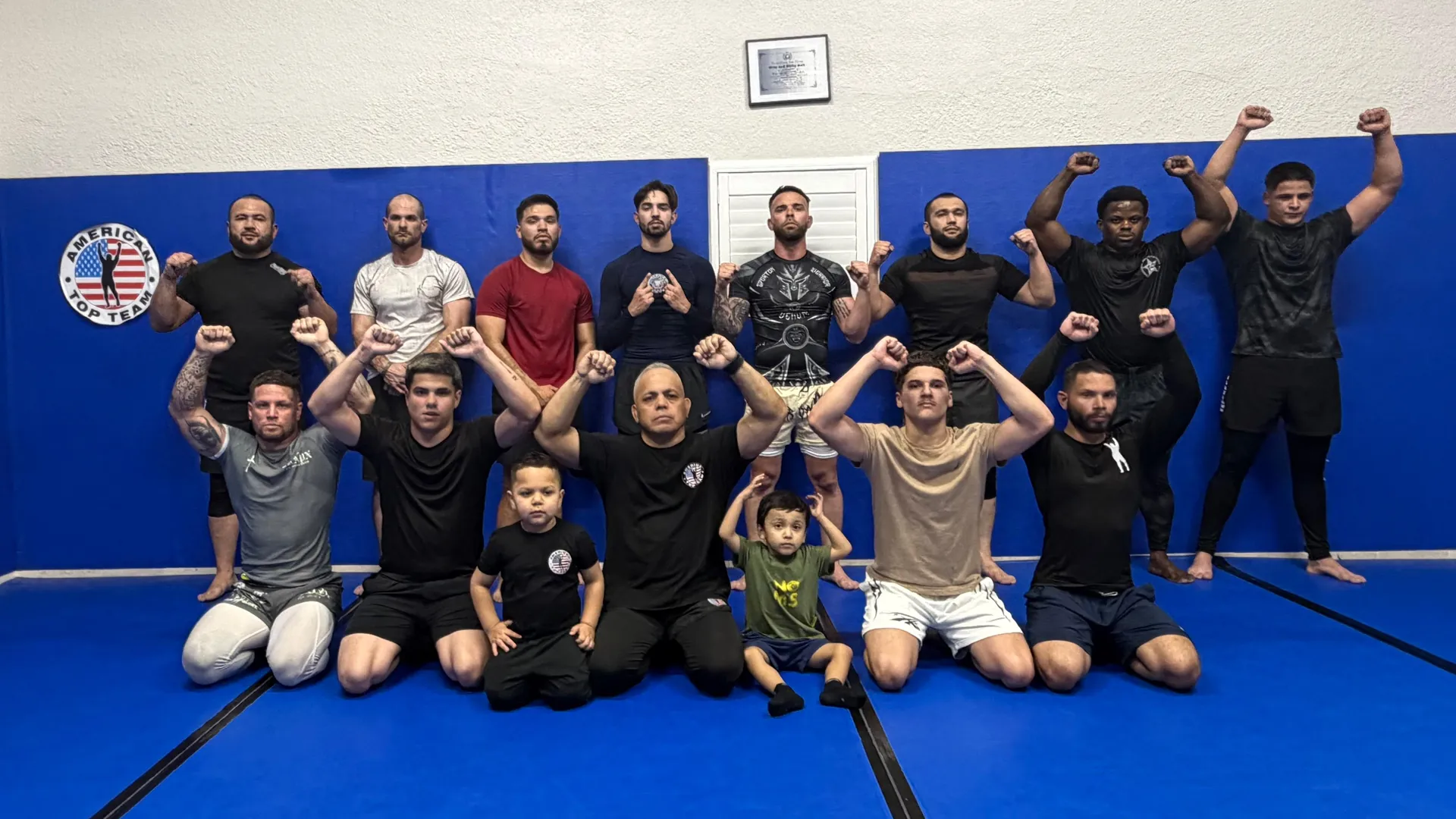
Here at ATT Fort Myers, also known as Team Hardoy, our focus is Brazilian Jiu-Jitsu for men, women, and kids, taught by Master Willy (Guillermo) Hardoy, a 4th degree BJJ black belt with roots in American Top Team Florida. Our approach reflects our motto: Discipline, Confidence, Respect, A Stronger You.
If MMA specifically is part of your long-term interest, the smartest first step is still the same one that has worked for decades of fighters before you: build the ground game. Message us on WhatsApp or call (239) 475-7105 and we can talk through your goals directly and help you figure out the right starting point.
Frequently asked questions
- Is BJJ part of MMA?
- Yes. Brazilian Jiu-Jitsu is one of the core disciplines inside Mixed Martial Arts, alongside striking arts like boxing and Muay Thai and grappling arts like wrestling. Fighters combine these skills under one ruleset, and the ground-fighting portion of nearly every MMA match draws directly from BJJ technique.
- Do I have to learn striking to train BJJ?
- No. Brazilian Jiu-Jitsu is a standalone martial art with no striking involved at all. Many students train BJJ for years purely for fitness, self-defense, and competition in BJJ tournaments without ever training a striking art.
- Which is safer for beginners, BJJ or MMA training?
- Generally speaking, BJJ carries a different risk profile than MMA because it does not involve striking or head contact the way boxing, kickboxing, or MMA sparring does. That is a major reason adults who want a lower-impact way to train often start with BJJ specifically.
- Why did Royce Gracie's UFC win matter so much?
- At UFC 1 in 1993, Royce Gracie, a Brazilian Jiu-Jitsu practitioner, defeated larger and stronger opponents from other martial arts backgrounds by taking the fight to the ground and using submissions. That result is widely credited with proving the value of ground fighting and pushing BJJ into gyms worldwide, including the foundation of many modern MMA programs.
- Should I start with BJJ if my goal is eventually to compete in MMA?
- Most coaches recommend building a grappling foundation first. Learning to control position, escape bad spots, and defend or apply submissions takes years to develop well, and a strong BJJ base tends to make the transition into full MMA training smoother down the line.
- Does Team Hardoy in Fort Myers offer MMA classes?
- Our current classes focus on Brazilian Jiu-Jitsu for men, women, and kids under Master Willy Hardoy. If you are specifically interested in MMA, reach out to us on WhatsApp or call (239) 475-7105 and we can talk through your goals and point you in the right direction.
Related services
Serving
Found this helpful? Make us a preferred source on Google.
Ready to step on the mat?
Book a trial class in Fort Myers. No experience needed, just tell us your program and the best time to come.