What Is Brazilian Jiu-Jitsu? A Beginner’s Guide
· By Master Willy (Guillermo) Hardoy
If you have ever typed "what is jiu jitsu" into Google after watching a clip online, you are not alone. Brazilian Jiu-Jitsu, usually shortened to BJJ, is a grappling martial art built around one simple idea: a smaller, smarter person can control and neutralize a bigger, stronger one by using leverage, timing, and technique instead of brute force.
Unlike striking arts, BJJ does not rely on punches or kicks. It happens on the ground and in close range, where positioning and joint mechanics matter more than raw power. That is exactly why it has become one of the most popular martial arts for everyday adults, including people who never considered themselves athletic.
This guide walks through where BJJ came from, how the core concepts work, what a typical class looks like, and how to take your first step on the mats in Fort Myers.
Where Brazilian Jiu-Jitsu Came From
The roots of BJJ trace back to Japanese jiu-jitsu and judo. In the early 1900s, a judoka named Mitsuyo Maeda traveled to Brazil and taught his grappling methods to a few local students, including members of the Gracie family.
The Gracies took those judo and jiu-jitsu fundamentals and adapted them over decades, placing heavy emphasis on ground fighting, leverage, and what to do when a fight ends up on the floor rather than standing. That adapted system became known as Brazilian Jiu-Jitsu.
The art reached a global audience in 1993, when Royce Gracie, a comparatively small competitor, won the first Ultimate Fighting Championship (UFC 1) against much larger opponents trained in other disciplines. That result is widely credited with introducing BJJ to the world and proving that technique and ground control could outperform size and strength.
The Core Idea: Leverage, Not Strength
At its heart, BJJ teaches that a trained person can control an untrained person on the ground almost regardless of size. This is done through positions, body mechanics, and joint leverage rather than muscling through an opponent.
Training revolves around a hierarchy of positions. Being on top, in control, generally beats being on bottom. Within that, there are specific positions, like mount or side control, that give one person more options than the other.
One of the most important concepts in all of BJJ is the guard, which is any position where the person on bottom uses their legs to control distance, prevent the top person from passing, and set up their own attacks. Far from being purely defensive, a good guard is often where many submissions begin.
From dominant positions, practitioners work toward submissions: joint locks or chokes applied with control, not snapped on violently. When a submission is tight, the person caught in it taps the mat or their partner to signal they want to stop. Tapping is normal, happens to everyone, and is simply how BJJ practitioners train safely at full effort.
What a Typical Class Looks Like
A beginner walking into their first BJJ class usually sees a familiar structure. Class opens with a warm-up to get the body moving and loosen the joints that grappling relies on most: hips, shoulders, and neck.
After the warm-up, the instructor teaches a technique or a short sequence, breaking it down step by step. Students then drill that technique with a partner, repeating the movement slowly so the mechanics become familiar before any resistance is added.
Many classes end with live training, often called rolling, where two students practice applying the day's concepts, or general BJJ skills, against a partner who is also trying to solve the same problems. Rolling is scaled to experience level: a good school pairs beginners thoughtfully and expects everyone to go lighter with newer students.
Nobody is expected to understand everything in the first class. The instructor's job is to walk a brand-new student through positioning and basic movement before anything resembling live training happens.
Gi vs No-Gi: What is the Difference?
BJJ is practiced in two main formats. Gi training uses the traditional heavy cotton uniform (the gi), which gives practitioners grips on the fabric itself and changes how certain techniques are applied.
No-gi training is done in athletic shorts and a rash guard, without the uniform to grab, which tends to make the pace a bit faster since there are fewer handles to control an opponent.
Both formats teach the same underlying principles of position and leverage. Most schools start new students in the gi because the grips make it easier to learn control methodically, then introduce no-gi concepts as skills develop.
The Belt System, Briefly
BJJ uses a belt system to mark skill progression, starting at white belt for every student regardless of background, then moving through blue, purple, brown, and eventually black belt.
Progress between belts is measured in years, not weeks, which is part of why the community tends to respect anyone wearing a colored belt: it represents real mat time. A black belt in particular reflects a very high level of technical knowledge built over a long period of consistent training.
New students should not worry about belts in the first few months. The early goal is simply learning to move, understanding basic positions, and getting comfortable being on the mat.
Who Is BJJ For?
One of the things that makes BJJ stand out among martial arts is how broad its audience actually is. Adult men and women who have never done a combat sport before regularly start as complete beginners and build real skill over time, because technique is designed to work for different body types and strength levels.
Women training BJJ often point to the same core benefit men do: a smaller person can learn to control a larger one through leverage and position, which is part of why the art has useful self-defense applications without relying on size or athleticism.
Kids benefit from BJJ differently. The sport rewards patience, problem solving, and composure under pressure, all of which carry over into school and everyday life, alongside the physical activity of a full-body sport.
In Southwest Florida, where year-round heat limits a lot of outdoor training options, an air-conditioned mat space running structured classes for adults, women, and kids gives families and individuals a consistent place to train regardless of season.
Benefits People Notice Once They Start
Most new students mention a handful of changes once BJJ becomes part of their routine. Physically, grappling is a full-body workout that builds grip strength, core stability, and cardiovascular conditioning without ever feeling like a traditional gym session.
Mentally, BJJ is often described as physical chess. Every roll is a live problem to solve, which sharpens decision-making under pressure and builds a kind of calm that carries over off the mats.
Many students also report a noticeable gain in confidence, not from aggression, but from knowing they can stay composed and think clearly in a stressful, close-contact situation. That composure, paired with real control and escape skills, is why so many people describe BJJ training as practical self-defense knowledge, even though no training replaces caution in real-world situations.
How to Start Training in Fort Myers
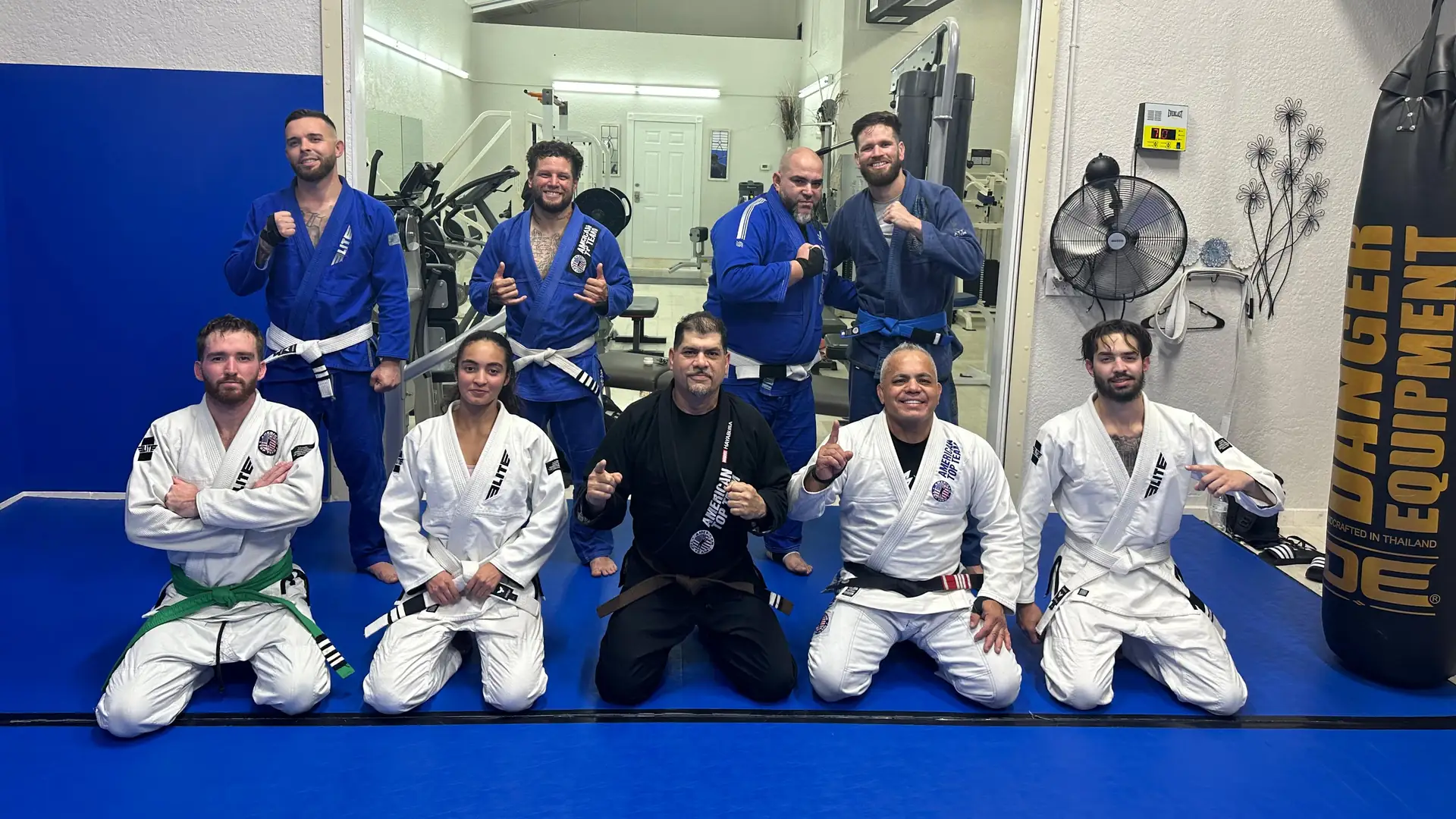
The most common question from beginners is simply: what do I wear and what do I do on day one? The honest answer is that a good school walks you through it. At ATT Fort Myers (Team Hardoy), head instructor Master Willy Hardoy, a BJJ black belt 4th degree out of American Top Team Florida, runs classes for men, women, and kids under one simple motto: Discipline, Confidence, Respect, A Stronger You.
Nobody expects a first-timer to show up knowing terminology, positions, or etiquette. The goal of a trial class is to get on the mats, meet the instructor, and see how the school actually teaches before committing to anything.
If you are curious about Brazilian Jiu-Jitsu and based anywhere in the Fort Myers area, the simplest next step is booking a trial class through the website form or by reaching out on WhatsApp at (239) 475-7105.
Frequently asked questions
- Do I need to be in shape before starting Brazilian Jiu-Jitsu?
- No. Most people who start BJJ are not in elite shape on day one, and conditioning builds naturally through training. Classes are structured so a complete beginner can participate at their own pace from the first session.
- Is Brazilian Jiu-Jitsu safe for beginners?
- BJJ is trained with control rather than full-force strikes, and the tap system lets a practitioner stop a technique the moment it becomes uncomfortable. A good instructor pairs beginners carefully and teaches safety and etiquette from the very first class.
- What should I wear to my first class?
- Comfortable athletic clothing is normally fine for a first visit. Most schools provide guidance on uniforms (the gi) or no-gi gear once you decide to continue training, so there is no need to buy equipment before a trial class.
- Is Brazilian Jiu-Jitsu good for self-defense?
- BJJ is widely used in self-defense training because it teaches control, escapes, and submissions that do not depend on being the bigger or stronger person. It is not a guarantee against every real-world scenario, but the positional awareness and composure it builds are genuinely practical skills.
- Can women and kids train Brazilian Jiu-Jitsu?
- Yes. BJJ is trained by women and kids worldwide, and many schools, including ATT Fort Myers, run dedicated classes for men, women, and kids so each group trains in an environment suited to their goals and experience level.
- How do I try a class in Fort Myers?
- The easiest way is to book a trial class through the website form or message the school directly on WhatsApp at (239) 475-7105 to set up a time to visit the mats.
Keep going
Related services
Serving
Found this helpful? Make us a preferred source on Google.
Ready to step on the mat?
Book a trial class in Fort Myers. No experience needed, just tell us your program and the best time to come.